Championing E-STEM in Uganda: The Story of TEEN 2 and the Green Champions Movement in Schools






E-STEM Stories: Branching Out shares stories of innovative E-STEM work from around the world. E-STEM engages students in meaningful, real-world environmental problem-solving that integrates science, technology, engineering, and math (STEM).
This post highlights the YES Global Initiative, a 2024 recipient of a Global E-STEM Award. These awards, which support both new and established global E-STEM initiatives, are made possible by Pratt & Whitney and the North American Association for Environmental Education (NAAEE).
This post is written by Richard Tusabe, founder of YES Global Initiative and the TEEN 2 Project Team leader (2024 E-STEM Award winner).
A Global Award, A Local Mission
In 2024, the YES Global Initiative in Uganda proudly joined a prestigious group of only 14 organizations worldwide to win the Global E-STEM Awards, a collaborative initiative by Pratt & Whitney and the North American Association for Environmental Education (NAAEE).
This award didn’t just recognize our past work—it fueled the next chapter of our mission. With this support, we launched TEEN 2 (The Environmental Education Nexus – Phase Two), our latest project to integrate Environmental STEM (E-STEM) education in Ugandan schools through the innovative Green Champion Clubs model.
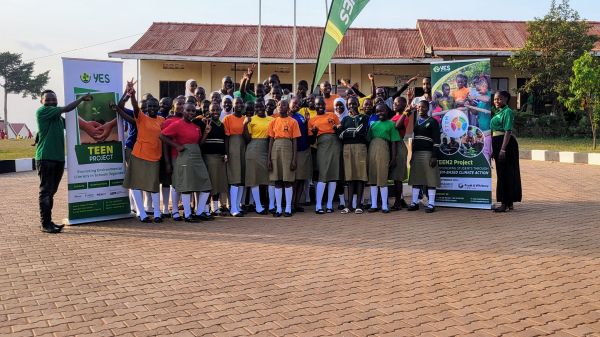
Today, thanks to this global award, we're empowering more than 120 young people aged 11–22 across primary and secondary schools in Uganda with practical climate knowledge, STEM skills, and the tools to grow their own food—and future.

The State of E-STEM in Uganda: A Wake-Up Call
In most Ugandan schools, climate and environmental education are still largely theoretical—often confined to textbook paragraphs or one-off lessons in science or geography. Though STEM subjects are taught, they are rarely linked to urgent, real-world issues like climate change, food insecurity, or sustainable agriculture. This disconnect often results in students having knowledge of environmental issues, but not the practical tools or purpose to address these issues.
Nevertheless, across Uganda, a quiet revolution is taking place in classrooms and school compounds—one that fuses science, environmentalism, and youth-led innovation. And at the heart of this movement is TEEN 2—The Environmental Education Nexus, Phase Two—a project of the Global Initiative for Young Environmental Stewards (YES Global Initiative).
With its roots in youth-driven environmental action, TEEN 2 is now redefining how science, technology, engineering, and mathematics (STEM) intersect with environmental education in schools, laying the foundation for what is proudly called E-STEM by our partners in the Global North. The project integrates STEM approaches into addressing environmental and climate-based challenges.


TEEN 2: A Hands-On Approach to E-STEM
Building on the foundations of the original TEEN project, TEEN 2 now focuses on integrating STEM directly into environmental education by using a school-based club model known as Green Champions Clubs. This dynamic initiative is cultivating a deeper understanding of environmental and climate action by seamlessly integrating E-STEM principles into the educational curriculum of two rural and city schools: Holy Family Junior School in Nakasajja and Spire High School in Kasangati Town Council in Kampala, where more than 120 students are actively participating.
What makes TEEN 2 stand out is its action-based learning approach. Through these clubs, students aren’t just reading about climate change—they're building kitchen gardens as a real-time demonstration of sustainable urban farming. These gardens become living classrooms, where students apply principles from science, engineering, and math to understand soil nutrition, plant growth, irrigation systems, and the impact of weather patterns. To ensure these gardens are not only successful but also serve as living laboratories for E-STEM learning, the project team works closely with dedicated teachers from both participating schools. This collaborative approach yields a wealth of creative ideas on how to implement urban kitchen gardening while strategically weaving in scientific principles, technological tools, engineering design, and mathematical analysis.
Breaking Barriers with Technology: Meet Akello
Recognizing that the future of environmental education must also be digital, YES Global Initiative has developed Akello AI (Environmental Query Assistant), an AI-powered educational assistant. Akello introduces students to digital tools that help them understand climate data, explore environmental topics, and ask questions in real-time—revolutionizing how rural and urban schools alike can learn about the environment, even amid infrastructure challenges.
Akello

This digital shift is especially important in Uganda, where many schools still face a digital divide. Akello helps bridge that gap, offering a glimpse of what accessible, tech-enabled E-STEM learning can look like even in under-resourced environments.
Lessons and Opportunities
TEEN2’s impact has already rippled beyond its initial two schools. Enthusiastic teachers, parents, and administrators have expressed a strong desire to scale the program further. One primary school teacher from Holy Family Junior School admitted it was the first time he had heard the term "STEM," despite being familiar with science and mathematics as standalone subjects. Now, he’s eager to integrate E-STEM concepts into classroom teaching and assessments.
TEEN 2 is not just a student movement—it's a whole-school transformation model. By applying E-STEM concepts, learners gain a profound understanding of sustainable practices and their potential to create a greener future, thus cultivating a generation of environmentally conscious and STEM-literate leaders.
The project’s momentum also aligns well with Uganda’s new hands-on curriculum, which emphasizes practical learning outcomes. This synergy offers a critical opportunity: for the Ministry of Education and Sports and the National Curriculum Development Centre to recognize and institutionalize E-STEM learning across the country.
Additionally, partnerships with organizations like AYDIA Gender and Technology Initiative and Joint Energy and Environmental Projects (JEEP) are enriching the TEEN 2 experience with training, mentorship opportunities, and practical expertise in sustainable agriculture and digital education.
Challenges on the Path
Of course, success doesn’t come without challenges. TEEN 2’s greatest obstacle is its popularity—demand is outpacing capacity. Whole schools want to join, and teachers are eager to build their capacity in E-STEM education, given their vital role working directly with students. However, budget constraints have forced the team to prioritize two practical training areas—kitchen gardening and AI-based learning—leaving many eager stakeholders waiting.
Additionally, the conventional school calendar often clashes with project scheduling, and unpredictable weather can affect outdoor activities. But these challenges are themselves learning moments, and the TEEN 2 team is responding with flexibility, creativity, and commitment.
What Lies Ahead
Looking forward, TEEN 2 aims to deepen its roots in participating schools while also scaling up. With additional support, the project hopes to:
- Expand kitchen gardening demonstrations into model agricultural labs in schools.
- Train more teachers in E-STEM approaches.
- Improve access to digital learning via Akello and other innovations.
- Build stronger public-private partnerships to extend the project’s reach.


Conclusion
In many ways, TEEN 2 is more than a project—it's a movement. It is reshaping how young people in Uganda learn about and act on climate change. Through practical gardening, AI tools, and passionate community building, TEEN 2 is giving students the tools to fight food insecurity, adapt to climate threats, and build a greener future.
As the demand for meaningful climate education grows, YES Global Initiative and its partners are standing at the forefront—not just teaching E-STEM, but living it.
